Tactile Scaffolding: Structuring the Canvas Before the Paint
Tactile Scaffolding: Structuring the Canvas Before the Paint
A blank canvas is traditionally viewed through an optical lens—a vast, open expanse of potential where an artist’s eyes guide the initial strokes of a composition. When a sudden stroke removes your physical sight, that open expanse ceases to be an inviting playground and instead becomes a chaotic void. Without visual horizons, a fluid medium can easily bleed past intended margins, composition structures can collapse, and the creative process can dissolve into a series of accidental gestures. For many, encountering such an unpredictable terrain prompts a retreat into safer, highly structured activities that require less spatial risk. However, true mastery is not achieved by fearing the void; it is achieved by physically constraining it. Reclaiming my authority at the easel required recognizing that before a single ounce of color could be introduced, the canvas itself had to be engineered. By establishing a rigid system of tactile scaffolding—utilizing physical tape grids, raised textures, and precise spatial mapping—the unmapped surface transforms into a highly predictable, manageable arena where creativity can be executed with absolute, unhurried precision.
The Mechanics of the Invisible Grid
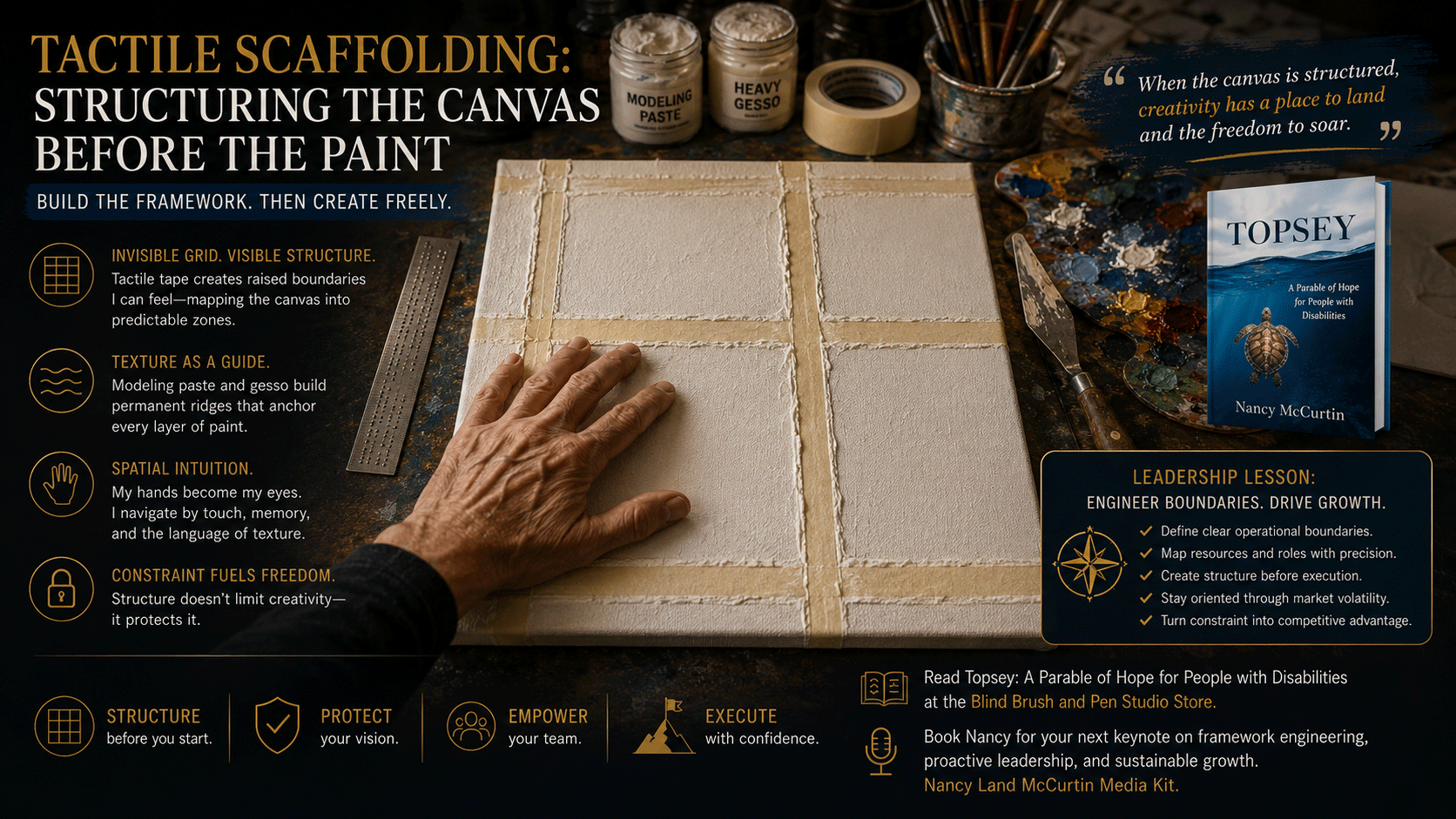
Operating a non-visual studio practice requires moving away from casual visual approximations and moving toward strict structural design. Long before paint tubes are even unsealed, the preparation phase begins with the meticulous construction of an invisible, tactile grid. I utilize heavy-duty, low-tack painter’s tape to divide the raw canvas into distinct geometric quadrants. This is not an arbitrary exercise; it is an act of mathematical zoning. The tape lines provide an immediate, raised boundary that my fingers can easily trace, mapping out the exact horizons, centers, and perimeter coordinates of the composition.
This physical layout demands an unhurried, highly disciplined level of concentration. Every tape line is measured from the edges of the wooden stretcher bars using fixed-length tactile rules, ensuring that the proportions perfectly align with the initial mental blueprint I have formed. Secondary layers of structural scaffolding are often introduced using thick modeling pastes or heavy gesso mediums applied along the tape edges. When these underlying materials cure, they form permanent, hard-edged ridges that remain fully perceptible even under multiple layers of heavy acrylic or oil paint. By organizing the blank canvas into this predictable, tactile matrix, the inherent anxiety of a non-visual workspace is eliminated. The surface is no longer a boundless mystery; it is a stabilized operational field.
Spatial Mapping and Spatial Intuition
Once the tactile scaffolding is securely fixed to the surface, the creative execution relies entirely on spatial mapping and deeply ingrained muscle memory. A sighted artist constantly steps back from the easel to judge balance, contrast, and layout visually. In my practice, the hand must act as both the eye and the engine. Before applying a medium with a palette knife, I scan the canvas with my non-dominant hand, using the raised tape grids and textured ridges as fixed navigational reference points. This continuous physical feedback allows me to know exactly where the knife stands in relation to the master composition at any given millisecond.
This intense reliance on spatial intuition alters the very relationship between the artist and the canvas. The work moves forward in a steady, metronomic cadence. The hand calculates the specific distance from a central tape axis, executes a heavy textural application of color, and returns to the tactile boundary to recalibrate for the next movement. There is no guesswork, no tentative reaching into a vacuum. The structural boundaries ensure that every thick layer of paint remains perfectly bounded within its designated zone. This methodical execution serves as a powerful testament to human adaptation, proving that when visual metrics fail, a disciplined internal blueprint can step forward to organize external reality with total authority.
The Danger of the Unstructured Initiative
The profound physical discipline required to build tactile scaffolding before painting offers an invaluable methodology for modern executive leadership. In the corporate and institutional worlds, leaders frequently fall in love with the “color” of a new idea—the broad strokes of an ambitious vision, a major product launch, or a sweeping digital transformation. Driven by market excitement, organizations often rush into execution, throwing resources at a blank slate without first mapping out the hard operational boundaries required to contain the effort. They treat the market as an optical playground where they can adjust on the fly, relying on trailing visual metrics like quarterly reports or dashboard KPIs to fix their mistakes.
However, when a major market disruption or unexpected competitive shift occurs, those trailing visual metrics can instantly lag or become completely obsolete, plunging the organization into a chaotic void. Without a rigid, pre-established operational framework, the corporate initiative quickly begins to lose its composition. Resources bleed across departments, budgets blow past their margins, internal teams lose their central focus, and the strategy dissolves into a series of reactive, damage-control gestures. Execution fails not because the vision was weak, but because the workspace was completely unstructured.
Engineering Rigid Operational Boundaries for Growth
True corporate resilience demands that leadership develop a philosophy of structural scaffolding before launching any major initiative into an uncertain market. Visionary executives must resist the temptation to execute prematurely. Instead, they must take the time to engineer rigid “operational boundaries” for their teams—clear, unyielding project parameters, strict resource limits, and defined behavioral standards that function exactly like the physical tape lines on my canvas. These boundaries must be so clearly articulated and structurally sound that every team member can “feel” them, knowing exactly where their autonomy ends and where the next department’s coordinate begins.
When an organization operates within a highly disciplined, pre-mapped framework, the threat of external market volatility is severely minimized. The team does not need to pause or freeze in a panic when conditions shift; their internal grid keeps them perfectly oriented. They can navigate through competitive transitions with steady, deliberate momentum, leveraging the structural muscle memory of their core organizational competencies. In my keynote presentations, I use the physical realities of my canvas preparation to show that true innovation requires constraint. By mastering the internal geometry of structural boundaries, a leader can confidently guide their enterprise into unknown territory, converting environmental chaos into a highly organized, self-determined competitive advantage.
To immerse yourself in this disciplined approach to personal autonomy, strategic risk management, and structural execution, secure your copy of the adult edition of Topsey: A Parable of Hope for People with Disabilities at the studio store. For corporations, universities, or executive forums looking to book Nancy for an elite, paradigm-shifting keynote on framework engineering, proactive leadership, and turning systemic friction into sustainable growth, please review availability via the official Nancy Land McCurtin Media Kit.
Nancy Land McCurtin
Blind Brush & Pen
Creativity Beyond Vision
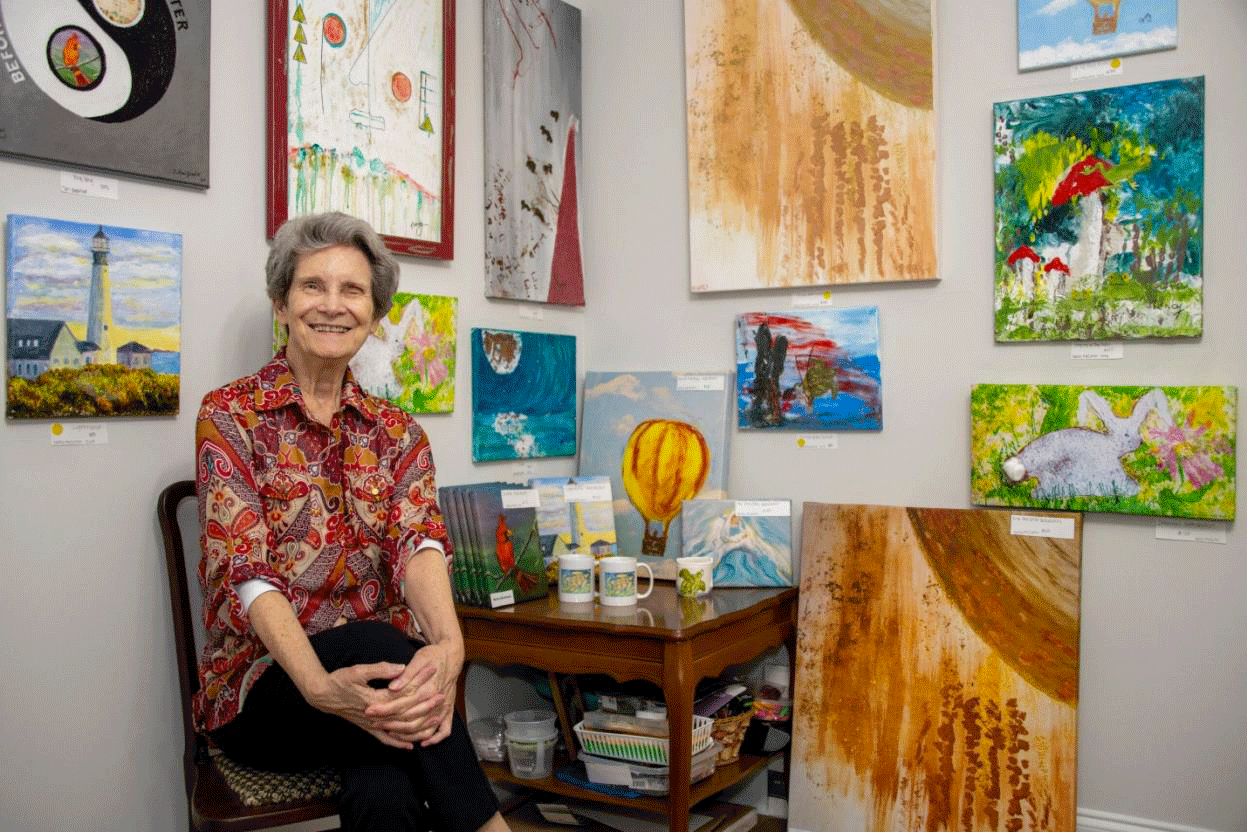
Nancy Land McCurtin is an American Abstract Expressionist, author, stroke survivor, and the founder of Blind Brush and Pen. After a stroke caused total blindness, Nancy rejected the passive narrative of coping and low expectations. Instead, she chose to weaponize the raw friction and recurring frustration of her reality, transforming intense emotional energy into a striking, sophisticated method of tactile mapping.
Operating entirely by touch, memory, and an unfiltered spiritual frequency, Nancy handles the canvas and the page with uncompromising authority. Based in Surf City, North Carolina, her mission is singular and fiercely independent: to create masterful art and powerful literature that shatters traditional boundaries and commands respect for the raw power of human resilience.
Books by Nancy | Digital Art Downloads | Featured Artwork Collection
American Foundation for the Blind | National Federation of the Blind | NC DHHS Service for the Blind