The Architecture of Friction: Painting Through the Storm
The Architecture of Friction: Painting Through the Storm
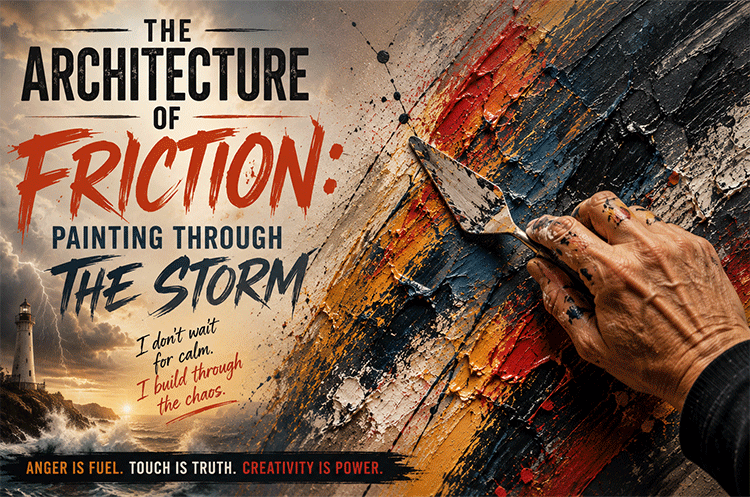
Society often prefers to treat artistic creativity as a gentle, quiet sanctuary. When you are a stroke survivor navigating unexpected vision loss, onlookers and observers frequently expect you to paint merely to find a soft, therapeutic distraction from your reality. They want your art to serve as a polite, quiet compromise with your circumstances. However, I have found that true creative adaptation is rarely a passive retreat. For me, the creative process is an active, profound engagement with a changing landscape. The deep, recurring frustrations and the daily complexities of an altered life are not roadblocks to my artistic expression. Instead, they form the actual, necessary scaffolding of my abstract expressionism. Discovering the architecture of friction means learning how to stop resisting the internal storm and start using its incredible, raw momentum to guide the medium across the canvas through the Blind Brush and Pen process.
The Navigational Reality of Focused Energy
When the external world becomes confusing, patronizing, or overly restrictive, I do not sit passively with my thoughts or wait for the emotional weight to lift. Instead, I channel that intense, focused energy directly into the quiet space of the studio. In my hands, frustration ceases to be an invisible mental burden and transforms into a tangible, creative asset. Understanding the architecture of friction requires looking closely at the deep mechanics of an abstract expressionist process built entirely on tactile awareness. I do not delicately mimic traditional forms to create a simple, comfortable visual for the casual observer. Rather, I build deep, intentional layers of medium directly into the canvas, letting the rich, unexpected textures mirror the real, complex contours of my experience.
This deliberate interaction with the canvas is exactly where my companion pieces, Sailing and Sailing Partner, pull their immense, steady power from. Every ridge of acrylic medium, every deliberate sweep of the palette knife, and every textured transition stands as a permanent physical record of an internal boundary being pushed back. Sighted viewers frequently look at my finished work and see a beautiful, chaotic squall, but they are actually looking at a highly disciplined, navigated journey through a storm. By mapping these intense emotional currents purely through memory, spatial intuition, and touch, I construct a structural reality that commands genuine respect. The canvas becomes a space where the well-meaning pity of onlookers is gently but firmly replaced by the undeniable presence of artistic authority.
The Tool of Navigation: Working with the Palette Knife
Sighted artists often rely heavily on the soft, fluid sweep of a traditional paint brush because it allows them to blend colors visually and soften structural transitions. But a soft brush cannot always capture the depth of real, persistent human resolve. In my studio, the solid edge of the palette knife has become an indispensable tool. The unyielding, clean edge of the knife provides direct, immediate tactile feedback against my hands. It allows me to feel the exact tension, resistance, and physical friction of the canvas beneath me. When I load the blade with thick, rich layers of paint and guide it across the surface, I can feel the vibration of the texture traveling up my arm. That physical resistance is the architecture of friction at work.
This process forces me to respond actively to the medium, to adjust my pressure, and to assert my presence onto an environment that frequently tries to minimize my capabilities. This is not passive mark-making; it is a high-level, physical negotiation where the paint and the artist work in tandem to find a new direction. In Sailing and Sailing Partner, the textures interact much like a boat hull interacting with a rough sea. There is resistance, yes, but there is also a profound momentum. The friction does not stop the progress; it provides the very leverage needed to steer forward.
Beyond Technique: The Mental Scaffolding of Growth
True self-sufficiency means refusing to let a sudden medical event or the lowered expectations of society sanitize your internal landscape. It is entirely natural to feel deep frustration when your physical independence is suddenly altered by a stroke. I refuse to wear a polite, perpetually smiling mask just to make observers or caregivers comfortable with my situation. Reclaiming my autonomy through the Blind Brush and Pen method meant recognizing that my raw, honest frustrations were actually the most generative, authentic tools I possessed. By fully embracing the architecture of friction, we discover that the storm does not have to destroy our sense of purpose. Instead, we can harness that very friction to build an independent space of creative depth and absolute personal authority.
For fellow creators, stroke survivors, and independent minds trapped in restrictive, well-meaning boxes, stop trying to suppress the deep passions inside you just to keep the environment around you comfortable. Your valid, complicated emotions are not a defect or a symptom to be treated away; they are a magnificent, structural source of power. When we map our internal navigation onto the world on our own terms, traditional limitations simply evaporate. Brokenness is never the final word. Rather, it is the gritty, fiercely authentic foundation where an unstoppable resilience and a masterful new form of fine art take root.
Sailing in Tandem: The Synergy of the Collection
The relationship between Sailing and its counterpart, Sailing Partner, speaks directly to the necessity of support structures through any major life transition. No vessel crosses a turbulent ocean entirely alone; it requires a deep understanding of the elements, a reliable framework, and a trusted alignment of forces. In these works, the contrasting yet complementary textures represent the dual nature of adaptation. One piece captures the solitary focus of navigating the wind, while the other embodies the grounding presence of a partner weathering the exact same swells. By exploring these themes through tactile abstraction, I invite the viewer to look beyond the superficial surface of disability and see the intricate, powerful architecture required to remain upright, moving, and entirely self-sufficient in the face of adversity.
To own a physical piece of this resilient, structural journey, explore original works and digital bundles at the Blind Brush and Pen Shopify Store. If your audience is ready for an unvarnished, high-value keynote on leadership, turning friction into fuel, and absolute autonomy, review Nancy’s availability via the Nancy Land McCurtin Media Kit.
Nancy Land McCurtin
Blind Brush & Pen
Creativity Beyond Vision
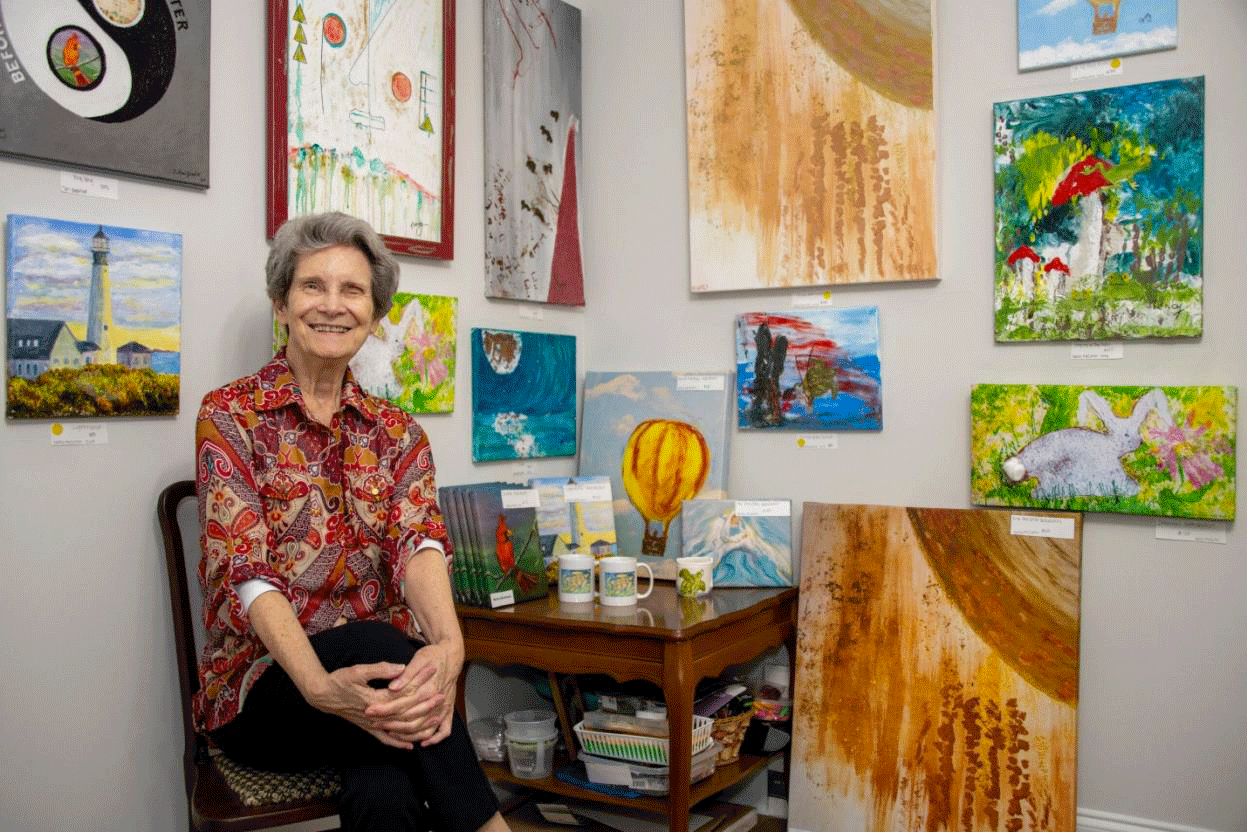
Nancy Land McCurtin is an American Abstract Expressionist, author, stroke survivor, and the founder of Blind Brush and Pen. After a stroke caused total blindness, Nancy rejected the passive narrative of coping and low expectations. Instead, she chose to weaponize the raw friction and recurring frustration of her reality, transforming intense emotional energy into a striking, sophisticated method of tactile mapping.
Operating entirely by touch, memory, and an unfiltered spiritual frequency, Nancy handles the canvas and the page with uncompromising authority. Based in Surf City, North Carolina, her mission is singular and fiercely independent: to create masterful art and powerful literature that shatters traditional boundaries and commands respect for the raw power of human resilience.
Books by Nancy | Digital Art Downloads | Featured Artwork Collection
American Foundation for the Blind | National Federation of the Blind | NC DHHS Service for the Blind