The Geometry of the Dark: Mapping the Everyday Environment
The Geometry of the Dark: Mapping the Everyday Environment
The human mind possesses an extraordinary capacity to construct order out of sudden chaos. When a stroke abruptly takes your physical sight, the immediate world does not simply disappear; rather, it transforms into an intricate, unmapped expanse of sensory data. In the initial months following such a profound medical event, the temptation to retreat into the passive safety of a couch can be overwhelming. The familiar rooms of one’s own home can suddenly feel like an unpredictable labyrinth fraught with unseen obstacles and navigation hazards.
For caregivers and well-meaning observers, the natural instinct is to cushion this environment, stepping in to guide every movement and manage every transitions. Yet, true self-reliance cannot survive in an environment of total insulation. Reclaiming absolute personal sovereignty requires stepping off the couch and engaging directly with the stillness of the dark. By treating spatial navigation not as a terrifying deficit, but as a structured problem of mental architecture, we discover that independence is entirely retrievable. It is found by learning to map the everyday environment through a disciplined, internal system built on precise geometry, muscle memory, and tactile landmarks.
Constructing the Internal Grid
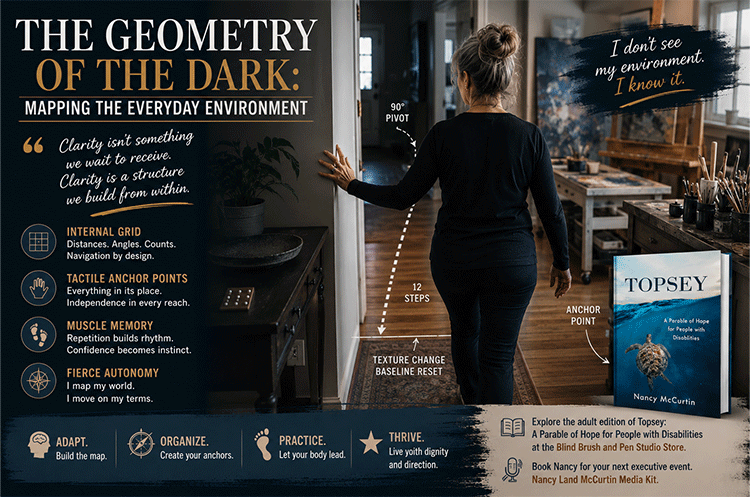
To navigate a non-visual world with confidence, an individual must systematically replace optical sight with an internalized architectural grid. Sighted individuals navigate through casual, ambient scanning; they move toward a doorway or a chair because their eyes register its location dynamically. In total darkness, movement must become far more deliberate and mathematical. Every room in my home has been quietly translated into an equation of distances, angles, and physical counts. I do not wander through a space hoping to encounter my destination; instead, I execute a precise sequence of calculated movements. A turn is no longer a casual adjustment of direction; it is a strict, ninety-degree pivot. A walk across the living room is not an approximation, but an exact cadence of measured steps calibrated to the physical dimensions of the architecture.
This internal grid requires a heightened state of environmental mindfulness that sighted people rarely have occasion to develop. Every threshold between rooms serves as a baseline for recalibration. The transition from the soft texture of a rug to the smooth, cool surface of hardwood flooring is not just a tactile sensation; it is a critical spatial coordinate. It tells my mind exactly where I stand on the master layout of the house. By organizing my surroundings into this predictable, geometric framework, the initial anxiety of vision loss gradually dissipates. The environment stops feeling like an unpredictable threat and begins to function as a familiar, supportive matrix where I can move with total autonomy and unhurried dignity.
Tactile Anchor Points and the Power of Placement
Within this geometric framework, individual objects serve as crucial tactile anchor points. For a non-visual studio practice or a self-sufficient household to operate smoothly, the placement of everyday items must become absolute. Sighted people frequently misplace keys, tools, or utensils because they rely on their eyes to scan a surface and find them later. In my world, an object left even two inches out of its designated location effectively ceases to exist, or worse, becomes a stumbling block. Absolute order is not an aesthetic preference; it is the literal foundation of my personal independence. Every brush, palette knife, tape dispenser, and storage container in the Blind Brush and Pen studio has a permanent, unvarying coordinate on the grid.
Establishing these anchor points requires a collaborative understanding with those who share the space. Caregivers and visitors must understand that moving an object “to clean up” or “to be helpful” without communication actually dismantles the architecture of my autonomy. When an item rests precisely where it belongs, I can reach out my hand with absolute certainty, knowing it will materialize exactly at the intersection of my muscle memory and spatial intuition. This meticulous discipline extends to the entire household. The corner of a heavy oak table, the specific alignment of a doorframe, or the tactile marker placed on an appliance dial are all anchor points that keep me grounded, centered, and entirely capable of managing my domain without external intervention.
The Cadence of Muscle Memory
The most profound element of this spatial translation is the development of deep, reliable muscle memory. The human body has an innate intelligence that operates independently of visual feedback. When a specific path—such as the route from the couch to the easel—is traveled intentionally hundreds of times, the mechanics of the journey shift from active mental calculation to subconscious physical cadence. The muscles learn the exact amount of tension required to navigate a particular curve, the precise lift of the foot needed to clear a low transition, and the subtle shifts in air pressure that signal a nearby wall or open hallway. This physical intuition allows me to move through my home with a quiet, fluid grace that belies the absence of sight.
This reliance on muscle memory creates a deeply meditative relationship with my physical surroundings. In the quiet hours of the morning, when I move through the studio, my steps are guided by a silent rhythm built over months of patient, focused repetition. There is no hesitation, no frantic reaching out into the void. Each movement flows naturally into the next because the body remembers the geometry of the dark. This seamless coordination stands as a powerful testament to human resilience. It proves that when one sensory channel closes, the remaining faculties can be trained to step forward, harmonizing to rebuild a life of uncompromised capability and personal dignity.
A Blueprint for Strategic Leadership
The discipline required to translate a physical environment into a geometric mental map offers a profound blueprint for modern organizational leadership. In the corporate world, executives frequently find themselves suddenly thrust into “dark” environments—periods of catastrophic market disruption, sudden regulatory shifts, or internal crises where traditional visual metrics and historical data no longer provide clear guidance. The natural corporate instinct during such times is to freeze, remaining static on the metaphorical couch until the clarity of the market returns. However, waiting for perfect visibility is a luxury that modern leadership cannot afford.
True executive resilience requires leaders to construct a new internal framework when their external metrics fail. It demands that they establish absolute operational anchor points, map their resources with geometric precision, and rely on the deep, structural muscle memory of their core organizational values. When I address corporate audiences, I use the physical realities of my spatial navigation to demonstrate how clarity is not something we passively wait to receive. Clarity is an active structure we choose to build from within. By mastering the internal geometry of a crisis, an organization can continue to move forward with a steady, deliberate momentum, turning environmental uncertainty into a masterful, self-determined path toward sustainable innovation.
To learn more about this disciplined approach to personal and professional autonomy, explore the adult edition of Topsey: A Parable of Hope for People with Disabilities available now at the studio store. To invite Nancy to deliver an authoritative, elegant keynote on spatial leadership and turning environmental friction into functional strategy at your upcoming executive event, please contact her team via the Nancy Land McCurtin Media Kit.
Nancy Land McCurtin
Blind Brush & Pen
Creativity Beyond Vision
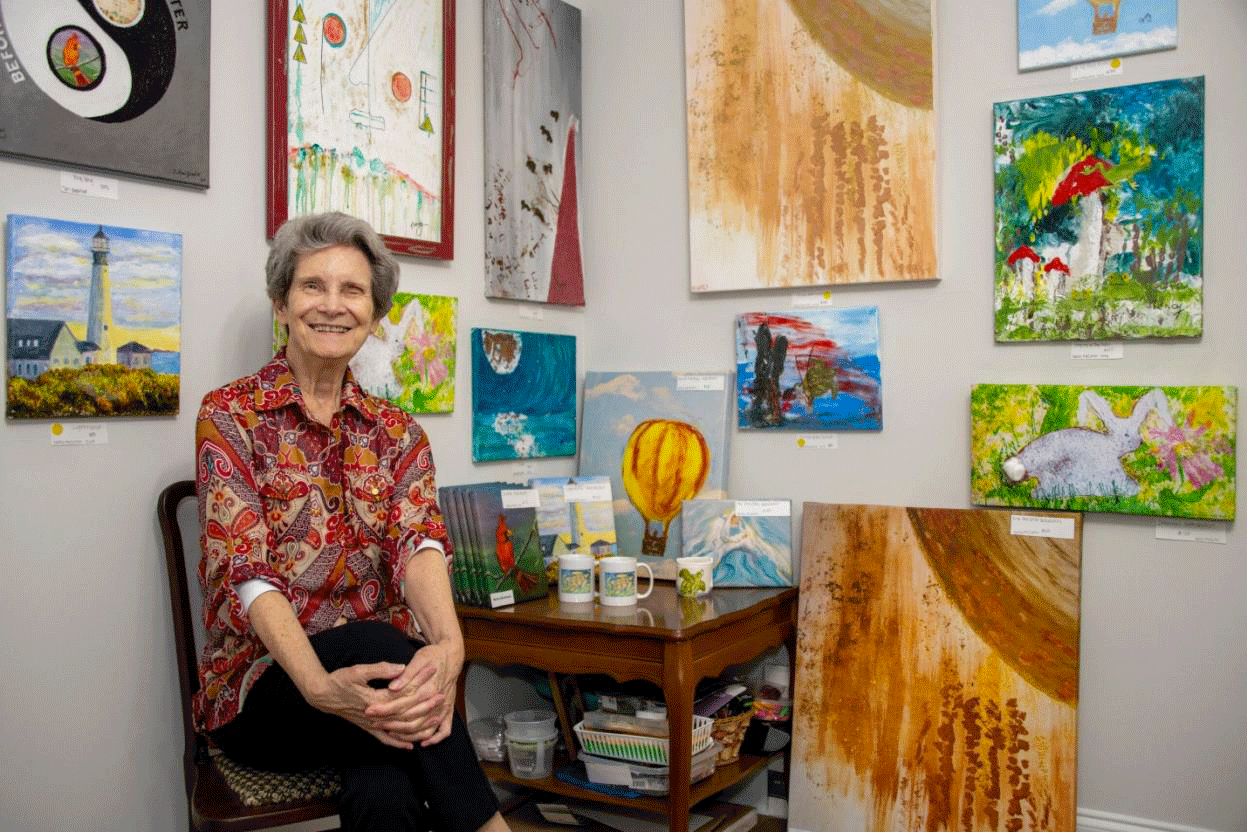
Nancy Land McCurtin is an American Abstract Expressionist, author, stroke survivor, and the founder of Blind Brush and Pen. After a stroke caused total blindness, Nancy rejected the passive narrative of coping and low expectations. Instead, she chose to weaponize the raw friction and recurring frustration of her reality, transforming intense emotional energy into a striking, sophisticated method of tactile mapping.
Operating entirely by touch, memory, and an unfiltered spiritual frequency, Nancy handles the canvas and the page with uncompromising authority. Based in Surf City, North Carolina, her mission is singular and fiercely independent: to create masterful art and powerful literature that shatters traditional boundaries and commands respect for the raw power of human resilience.
Books by Nancy | Digital Art Downloads | Featured Artwork Collection
American Foundation for the Blind | National Federation of the Blind | NC DHHS Service for the Blind